
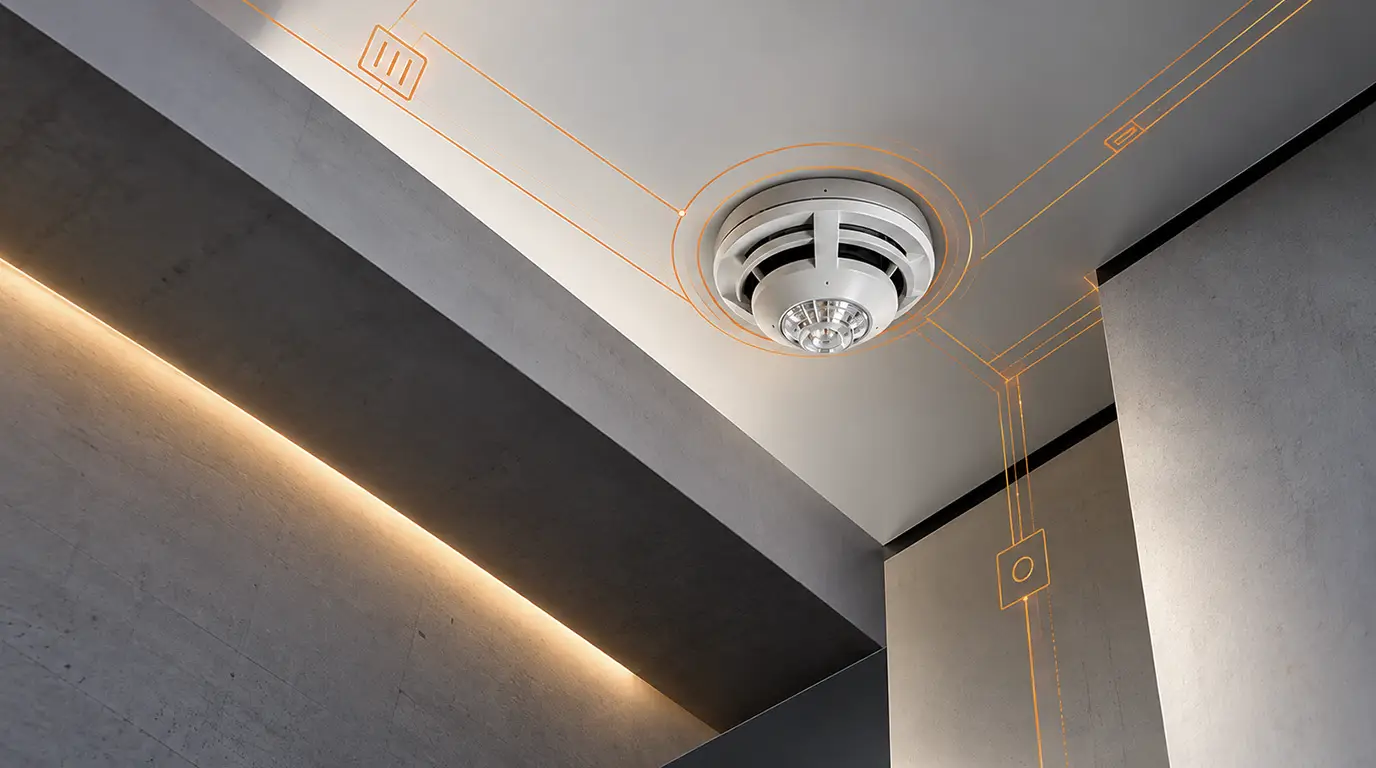
Self-Test fire detectors free up time from repetitive tasks, without diminishing the role or expertise of fire safety maintenance professionals.
There are a number of recurring objections surrounding Self-Test fire detectors that deserve to be addressed for what they are, without dismissing them too quickly.
The most common ones can be summed up in three questions: if the detector can independently verify its own functionality, what is left for the maintenance technician to do? Is there a risk of devaluing a skilled profession by reducing it to lower-value work? And who can guarantee, and with what evidence, that this self-diagnosis is reliable and compliant with the relevant standards?
These are legitimate questions. And they deserve precise answers.
Self-Test does not replace fire safety maintenance
The starting point is that Self-Test was not designed to replace maintenance, but to make it effective: compliant not only on paper, but in practice.
It should be considered within a context that anyone working in the industry will recognise. On the one hand, there is a structural shortage of qualified technicians, particularly pronounced in Southern Europe and consistently confirmed through direct discussions with maintenance companies. On the other, those who sign maintenance reports are facing increasing responsibilities: they are no longer simply expected to carry out the work, but also to document what was checked, when it was checked and under what conditions.
It is within this context that automating certain operations takes on a different meaning: not replacing expertise, but allowing it to be used where it is genuinely needed.
Fewer repetitive tasks, not less expertise
This is where the most significant objection needs to be addressed: the concern that this type of technology could somehow “reduce the level of expertise” required in maintenance.
The distinction is clear and worth emphasising: Self-Test does not eliminate expertise. It eliminates repetition.
It does not remove the need for visual inspection, technical judgement, an overall assessment of the system or the signature of the professional who takes responsibility for what they declare.
What it does reduce is mechanical, low-value activity, such as testing sensors one by one using test aerosol cans, which can currently take up a significant proportion of a technician’s time without making meaningful use of their expertise.
This does not mean devaluing a profession. It means freeing up skilled time and directing it towards activities where a maintenance technician’s expertise creates greater value, across an installed base that can be difficult to cover efficiently with the resources currently available.
The cost of maintenance is not just the cost of the detector
This consideration also leads to the economic argument, which is often reduced simply to the price of the device.
For anyone managing a maintenance contract for a fire detection system, the cost to consider is not simply the list price of an individual detector, but the overall cost of the activity: labour hours, testing materials, potential system downtime and the exposure associated with testing operations.
The ability to verify every point in significantly less time makes it possible to allocate technical resources to higher-value activities, improving the overall efficiency of the service.

How Self-Test fire detectors work
The question remains: who performs the checks, and how? It is precisely by looking at how the technology works that the objection can be addressed.
Self-Test is not an abstract form of self-diagnosis: when activated by the CLSS system, the detector heats a paraffin capsule that generates real smoke inside the device, thereby verifying its actual detection capability.
It is a test using real smoke, not a simulation, replacing the manual point-by-point test performed using aerosol cans.
The same test then measures the time taken for the smoke to leave the optical chamber: if the smoke takes longer than the specified threshold to clear, this means that the chamber is obstructed and the system reports the masking condition.
A single operation therefore provides two pieces of information that, with the traditional method, required separate attention and were not always guaranteed: the detector’s actual functionality and the condition of its optical chamber.
Self-Test and UNI 11224: the role of the maintenance technician
In terms of compliance with UNI 11224, none of this takes anything away from the maintenance technician.
The visual inspection required by the standard remains entirely the technician’s responsibility, supported by the Bluetooth technology built into each sensor, which provides direct and documentable access to the status information of each individual device.
Self-Test automates the repetitive functional test and makes it traceable; technical judgement and inspection remain exactly where they belong.
Verification and responsibility
It is particularly in terms of responsibility that the benefit becomes tangible.
In many contexts, manually testing every point in a system can be demanding in terms of both time and resources. The result is a certification based on a partial check.
An automated and traceable test, on the other hand, makes it possible to verify every point and retain evidence of the results.
For the person signing a report, the difference between certifying a sample and being able to demonstrate an extensive, documented verification is not a minor detail: it provides protection.
In a context of increasing responsibility, this is probably the aspect that matters most.
The maintenance technician’s role changes where it makes sense for it to change
No technology is suitable for every scenario, and Self-Test is no exception: it is not intended as a universal solution, nor as an alternative to those who know how to carry out maintenance properly.
Its value becomes clear where operational continuity is non-negotiable, where technical resources are scarce and where being able to provide solid evidence of what has been declared becomes critical: precisely the situations where cutting corners is not an option.
The market will be the judge, as it should be; but where technicians are in short supply and responsibilities are increasing, the direction is fairly clear.
It is understandable that a technology which automates part of the work may initially raise concerns about reducing the role of the maintenance technician. It is a reaction that accompanies almost every significant innovation in the industry.
The right question, however, is not whether the technician’s work changes, but which part of the work changes.
